
Description
General Description
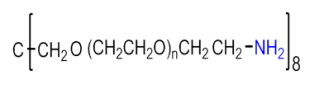
4-Arm PLGA-NH₂ is a multifunctional biodegradable polyester designed for advanced drug delivery and biomedical applications. The polymer consists of four PLGA chains radiating from a central core, with each arm terminating in a reactive primary amine group.
The amine functionalities provide versatile sites for covalent attachment of peptides, proteins, antibodies, targeting ligands, fluorophores, and other biomolecules. Compared with linear PLGA derivatives, the multi-arm architecture provides significantly higher end-group density, allowing efficient preparation of multifunctional nanoparticles, targeted delivery systems, and crosslinked biomaterials.
Upon hydrolysis, the polymer degrades into lactic acid and glycolic acid, making it suitable for biodegradable pharmaceutical and biomedical applications.
Applications
- Drug delivery systems
- Polymeric nanoparticles
- Injectable biomaterials
- Controlled drug release
- Hydrogel formation
- Tissue engineering
- Regenerative medicine
- Surface modification
- Protein conjugation
- Nanomedicine research
Features and Benefits
- Star-shaped PLGA architecture
- Biodegradable and biocompatible
- Higher end-group density than linear PLGA
- Enhanced drug loading capability
- Tunable degradation properties
- Suitable for hydrogel and nanoparticle fabrication
- Available in various lactide:glycolide ratios
- Functionalization-ready polymer platform